Monday, 28 September 2015

The Nordkapp Forti - Rob's First Impressions

Pic by Selwyn Gotleib
When the Valley guys announced that they had a revamp planned for the iconic Nordkapp, our interest piqued, and we've been looking forward to seeing what this 'old-is-new-again' Nordkapp Forti would deliver. This latest incarnation is inspired by one of the earliest versions of the boat but with many a modern twist.

On Saturday we launched Australia's first Nordkapp Forti for a leisurely paddle on Sydney Harbour and I immediately enjoyed the glide and easy manner of the boat. By way of contrast  on Sunday I launched out of Malabar and paddled the boat whilst coaching off the cliffs, in 15-20 knots southerly winds and some moderate southerly swell. 

Pic by Selwyn Gotleib
Immediately apparent is that this is a straighter tracking kayak than the 2008-edition; it's easier to surf and demands less work to hold a line at any angle to the wind. I suspect it's more efficient and it is definitely more stable and predictable in multidirectional waves. The profile shape is just as elegant as ever but from most angles this redesign looks a more contemporary version rather than a retro design. 

Pic by Selwyn Gotleib
I must admit I really like the looser tracking of the 2008 version but I have had a long time to get used it and know it is a highly idiosyncratic aspect of the boat that polarises opinion; many will see the slightly firmer and more predictable tracking of the Forti as a better compromise. What is so impressive is that with a few subtle changes this boat is easier to paddle, more forgiving and yet still retains that lively and engaging feel that is the hallmark of the previous Nordkapps.
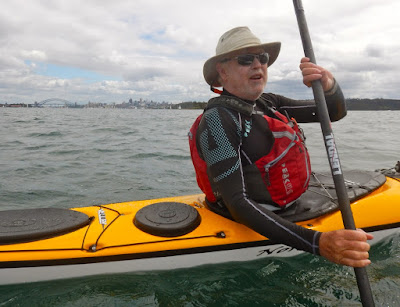
Pic by Selwyn Gotleib
Aesthetically the new boat has less pinched ends and fuller sections at bow and stern, the foredeck is less peaked at the centre but higher over the knees forward of the thigh braces, and the coaming is recessed to keep it low and streamlined.

It is another beautiful looking boat that will not only appeal to Nordkapp aficionados but also to those who may have found the looser tracking 2008 version a little too much in rough water. It will not replace the LV for feel or playfulness but at first test seems to have the previous full sized models covered. I look forward to further trials in surf and heavier weather. 


Testing boats is a tough gig but someone has to do it!

(Thanks to the Dapper Doctor Selwyn for riding shotgun & taking a few nice snaps)

Tuesday, 22 September 2015

Going the Distance

A couple of years back a local surf club identity, Steve, tried to talk me into entering the race he organises each year, the Royal Challenge. It involved a 22km trail run with an 11km ski paddle either side of it, and my reaction to his invitation was, 'I'd do the paddle bit, but I'm not a runner, never have been, never will'.

Thinking on it later in the day I thought about what a rubbish answer that was, that it was a cop out, decided it might be worth a go, how hard can running be anyway, and set in motion a path that my goal-oriented personality would ensure had only one logical conclusion. 

Now I've never been a runner, even in my rugby days I was more inclined to run into someone than try to run around them. I had no inclination whatsoever to run. Three seasons of club time trials & swims with the big hearted & encouraging people at the Brighton Athletic Club, a bunch of fun runs & more committing half marathons, the slightly silly Tough Mudder with my mate Tony, the very demanding Royal Challenge itself (where I was dead last out of 100 runners over the 22km), all fed a growing desire for more. Time, people, to join the exulted pantheon of Polynesian marathon runners!
Finishing the run leg of the Royal Challenge
I'd often heard people talk about marathons & figured it was just something to do, 'sounds like a nice challenge' etc etc, but not really anything like braving the wild seas with the wind in your hair. Like most people who've never given it much thought, I hadn't even considered the sheer brutality of the training you need to do, just to get yourself in a position to consider running 42.2km. My training regime built from what at the time seemed like an awful lot of running, about 25km a week, to an unthinkable 60-70km a week at it's peak, as I slowly built up the muscle endurance to weather the punishment of long distance.

I've never dedicated this kind of time to a paddling endeavour, with only the North Reef Expedition in 2011 generating the same motivation to make sure I'd prepared well. The real motivator...? Fear of course. For North Reef, it was the fear of putting my paddling mates under pressure, and potentially in danger, by tanking on a long crossing. For the marathon, it was a genuine fear that I'd bitten off more than I could chew, and just wouldn't be able to do it. The fear wasn't quelled any by a series of attempts to run longer and longer, which invariably ended with a geriatric shuffle after 20km. More than a few of my kind mates pointed out that there aren't many 95kg marathoners at the Olympics.... 

I had a breakthrough a couple of months ago when I employed my long distance paddling-fuel strategy to a 25km training run, and finished it strongly. It was a humble eureka moment, where I went from not really believing I could do it, to a 'strong glimmer' of hope that I could. People who know me know that I don't generally lack, umm, confidence, but this was realistic confidence (for once). I found a training partner in my mate Glenn, who not that long ago was lying busted under a semi trailer which had squashed his commercial van, with leg injuries serious enough to demand over a year of full-on rehab, so inspiration to dig in was never far away (Glenn ran a fantastic 3 hour 54 minute marathon).

With all the training done & the dreaded tapering fortnight over, a tormented couple of weeks hand washing like a surgeon, dodging the contagious bugs swirling around my family like an East Coast Low, hacking coughs from one bedroom replaced by projectile vomits from another, the day finally arrived.
Completely freaked out before the start.
They say the hardest part of a marathon is getting to the start. Avoiding injuries, scrimping the time to train & train well enough to approach it with confidence, none of them things to be underestimated. Lining up with the thousands of people attempting the distance was something of an honour.  Knowing that they'd all most likely been out there in the early mornings, like me doing their 30km long runs, planning, obsessing, basically consumed by the whole thing, felt very reassuring. I didn't feel like the mad bastard anymore.
The rev-up over, the gun fired & we were off. I'd heeded warnings about going out hard, and settled into a very conservative pace, being dragged along in the throng of humanity across the Harbour Bridge, over the Cahill Expressway & up Macquarie St towards Hyde Park. I'd mentally rehearsed the route many times, it became my bedtime video, playing in mind as I plodded along the city streets.

As I cleared the city and made my way up Oxford St, I started to see significance in the course. It was a strange thing to drift into, and lets face it you have to have something to distract you from how much it hurts, but I got lost for at least an hour in the memories of the places I was passing. 

Halfway up Oxford St I passed the legendary nightclub. Rogues, where as a 17 year old I spent my Friday nights picking up glasses and observing the rich & famous downing Stolichnaya shots & trashing themselves. Down Moore Park Rd & past the footy stadium, which was once the Sports Ground, where I've seen Jonah Lomu rampage and the Roosters play from the days of Horrie Hastings right up to the days of his son, then along past the SCG where I watched heroes like Viv Richards & Dennis Lillee. A cutback took me past my old school, Sydney High, where I was surrounded in equal measures by beach-suburb larrikins who remain my great mates to this day, & very, very bright kids (yes they're mutually exclusive qualities). Approaching Centennial Park I passed the unit block where Mum & I had our first flat in Sydney, & I remembered staring out as an eight year old at the expanse of a huge city from the positively stratospheric 6th floor, quite a change from our modest little farm in NZ. Into Centennial Park where I spent most of my youth playing sport or playing in the mud, and then out onto Anzac Parade where the trip down memory lane was replaced with a wildly premature revelation that at 28km, I was on the way home.
Chariots of Fire down Oxford St.
I'd been mentally rehearsing striding the long downhill back down Oxford St, crowds cheering, fist raised in a victory salute as I powered the final third of the course, but the reality of the marathon for me was that by this stage the downhill allowed me only a slightly faster shuffle than the flat bits. Running through the trees of Hyde Park again & then down the hill back to Circular Quay I got a big lift from my Mum, standing on the curb cheering like mad and urging me on. '10km to go, you can do it', she hollered. I felt great, only 10km to go.

My mate Knighty had warned me that the marathon only really starts at 35km, everything up to that point is the cruisy bit to get you into a position to withstand the rigours of the last few miles. The Sydney course quite obscenely sends you up onto the Darling Harbour flyover, and as you hit the mythical distance where runners speak in hushed tomes about 'the wall' there is a dirty great hill. I was secretly pleased that the 50 runners within shouting distance of me also decided it was a dirty great hill, as basically every one of them slowed to a walk for the 40m required to get to the top. People around me were starting to look very shabby, the chirp had gone, the smiles were replaced by gritted teeth. To my paddling mates, imagine an event like the 47km Myall Classic, where at the 35km mark people literally started dropping their paddles, and falling out of their boats with exhaustion. And swearing....
42.2km is a VERY long way.....
This part is very hard mentally, sure you're hurting, but you expect to be hurting. What you don't expect is the overwhelming urge to stop & walk. The mistaken urge that walking will make it easier, even down to calculating when you'll finish if you walked the last 5km. At the top I forced myself to run again, enjoyed the slight downhill to the Powerhouse Museum, and just as I was starting to feel very sorry for myself on the final big incline a guy who had bounded past me stopped with what looked like a cramp. As I shouted a word of encouragement I looked down & realised it wasn't a cramp; he was adjusting his prosthetic leg. Suffice to say I drank a pint of concrete and decided that my wall was only a little wall.
Running the last couple of kilometres to the finish was like taking Ibuprofen via the cloud,  the pain in my feet & legs dulled by the sight of the harbour, the bridge, then the Opera House, and finally the long chute lined by a cheering crowd which you traverse to the finish line on the Opera House steps. In my mind I was running like Richie McCaw, striding on to the finish line with power & purpose. It's only when I saw the finish video that I realised how buggered I looked, more like Lionel Richie! Crossing the line is one of the great things you can experience.

My time was 4.45, which was to-the-minute what I figured I was capable of based on all my training. It was a good feeling indeed to have done it in the style I'd hoped for, without the teary war story, and with a brilliant minds-eye memory of running a marathon, a tremendous, positive experience. There is a lot to be said for preparing properly for serious things, and there is nothing as committing as commitment.
Glenn & I with our medals
As for Steve, he now directs the very successful swim/paddle/run Hydrothon franchise, and moaned to me the other day that it would be great if he could get more runners, like me, to cross over! Cheeky bugger.

Tuesday, 28 July 2015

Cruising the Royal


My mates from the Sutherland Shire Canoe Club invited me along last Saturday for their weekly sea paddle from Bundeena south to Little Marley Beach & back. All up it's a 20km return trip & one of the most scenic, although committing paddles, you could hope to fit into a winter morning.

On this particular day the weather was uncommonly kind, with no wind to speak of, and a minimal groundswell allowing us unfettered access to the fortress-like sandstone cliffs that line the route. The video below shows just how benign it was, and I was pleasantly surprised when I watched the raw footage to see the clarity of the water through the GoPro lens, just magic.

Rob was busy fitting out the Evoke & Pace 17 for an upcoming trip, and as usual he had all the fun boats, Nordkapp LV, Xtra & Xcite at his place, so I turned a little mournfully to the Pace 18, knowing it'd preclude me from manoeuvring in & out of the myriad rock pools & gauntlets that for once, would be open for exploration. 

After the first 2km of the paddle shot past with the GPS hovering around 10kmh, I was grateful for the speed of the Pace, and a quick look around the group should have reminded me of what I was in for. The double kayak had the better half of current mixed double National marathon champions, the back seat was occupied by the current cup holder in the mixed double ski class for the Hawkesbury. The better half of that champion ski combo was paddling a pretty slippery single, and the other two singles were occupied by Hawkesbury record holders. I was relieved when they told me they were saving themselves for a marathon the following day, otherwise I would probably have busted a boiler keeping up....

The paddle down to Little Marley was bathed in early morning light, and the hues of gold & brown in the cliffs were something to behold. Better still, we were able to paddle within touching distance of the cliffs for most of the journey, a rare treat along a stretch which generally varies between industrial & nuclear powered rebound.

As we turned into Little Marley Bob, Kate & Kristie were treated to a couple of whales playing in the morning sun, complementing the seals, dolphins & sea birds we'd already clocked up. We also had the pleasure of being chased by a school of pilchards; forget the cetaceans, you haven't lived until you've heard the mighty roar of breaching pilchards up close.

A stretch & some pics on the beach, & back in the boats for the paddle back, again treating ourselves to the spectacular cliffs, right in tight. You know it's calm when you can see the sea urchins...

Truly one of the nicest days on the sea you could imagine, a good workout, some amazing scenery, wildlife & a few laughs with a great bunch of people.

Tuesday, 14 July 2015

Valley, North Shore & Rockpool Kayaks Cut Off Date July 27

Our next shipment of Valley, North Shore & Rockpool Kayaks is due to leave the UK in late August, and we have a box full of custom boats, made for customers who've picked their colours, layups & features.

The cut off date for the next shipment is looming, a week from today on July 27.

The next shipment also features the brand new Nordkapp Forti, Valley's latest take on their most famous classic design. Reviews from the UK have pointed to it's impeccable lines, superb behaviour downwind, and many are hailing it as the best Nordkapp yet. Valley's press release with all details about the boat is HERE.
The Nordkapp Forti
Also available for the first time is the new Rockpool Tarantella, another fast tourer for the lighter paddler.

If you'd like to have a Valley, North Shore or Rockpool boat made the way you want it, with a clear carbon kevlar hull, or in colours to match your dream design, then please let us know.
Those of you who have been eagerly awaiting the return of the Valley Gemini SP RM, rest assured you'll have your boat prior to the coming warmer weather. We have all three colours coming & plenty of stock. Here's a reminder of just what this awesome little playboat is capable of.


Wednesday, 8 July 2015

Winter Safety - The rescueME EDF1 Electronic Flare & Delorme inReach Explorer


The water has gotten cold, daylight hours have shortened, and general safety margins on the sea are lower at this time of the year than they are at any other.


Now more than ever it's important to be diligent with your float plan, and carry the right kit to minimise your exposure in potentially cold water if something does go wrong.


Even a simple afternoon paddle of 16km around the Cape Bailey & Solander peninsula with a mate last week was something to be taken very seriously, and that was without any marginal weather. As a minimum, I considered it pertinent to let Rob know our launch spot, expected finish time & place, potential get-out points, and also committed to a call at the time I expected to be safely off the water.


I was also testing out a new addition to our range of safety gear, the Delorme inReach Explorer. This has a similar tracking functionality to the well regarded SPoT tracker, with the very big additional feature of two-way communication via satellite SMS. So unlike SPoT which allows a pre-set message to be sent with the press of a button, the Delorme inReach Explorer allows a 160 character text message to be sent with GPS co-ordinates to a mobile phone or email account, Facebook or Twitter, to which your receiver can reply. It also has the SOS feature that your PLB or SPoT carry, although it's not meant to replace an EPIRB or PLB for sea kayakers, as the emergency message is beamed to in international hub before being relayed to AMSA. 

Our Delorme inReach Explorer secured to Mark's Swordfish footwell.
The tracker drops a map pin every 10 minutes, which Rob could have referenced if he was concerned about us not making our call-in time (see below):

It's Waterproof and dustproof (IPX7 - withstands incidental water exposure of up to metre for 30 minutes), with a battery life (sending one track point every 10 minutes) of 100 hours via an internal lithium polymer battery. The unit costs $529 through our ONLINE STORE, and you can then log into the Delorme international site & subscribe to any one of a multitude of subscriptions depending on your requirements. We have ours hooked up to a $16.00/month plan which gives us more text & pin drop messages than we could hope to use other than on an extended expedition.

The other new addition to our safety electronics range, and one we've only been able to test to dazzling effect in our store with all the lights out, is the rescueME EDF1 Electronic Distress Flare.

Again, whilst not legally an alternative to a red night flare, this device has myriad advantages over the traditional beacon. Unlike single use pyrotechnic flares the rescueME EDF1 can be used repeatedly in any of its four modes, ensuring continued visibility is maintained over a longer period. 

The unit is both safe to store and operate while also eliminating any worries associated with disposal. It has a number of modes, including a setting that points the quite extraordinarily bright red light away from you, and another than pulses SOS. To a rescuer, it very accurately simulates the visual signature of a red night flare, so there can't be any confusion over what the bright light on the visual horizon means. All up a very impressive piece of kit, and at $189 it pays for itself over the course of a couple of years as flares inevitably pass their use-by-date. The rescueME EDF1 is available through our ONLINE STORE for $189 delivered.

Tuesday, 30 June 2015

Around the Capes, Surfski for Fun....


My mate recently bought himself an elite Think Uno Max, a ski which feels like it has an outboard attached on flat water, but requires dedication to paddle in the rough stuff.

Without a background or any particular interest other than as a participant in surfski racing, I've come to regard skis as a great tool for a workout, a fast & uncomplicated craft for a couple of hours of hard paddling, with the added bonus that in any sort of following conditions they are absolutely, entirely brilliant. This kind of scenic and, due to nearly 6km of unbroken & unlandable cliffs, committing paddle is one I'd normally reserve for a sea kayak, but with Steve keen to get out & mix it up in his new ski we decided to have a crack.


A superb Sydney winter afternoon beckoned us out to sea, virtually windless. We set up a car shuffle, and left the sandy beach at Gunamatta Bay in mirror calm. Progressing around the point named after George Bass & Matthew Flinders, we then struck out across the 7km expanse of Bate Bay to Cape Bailey, an imposing sandstone wall that marks the southern edge of the Capes cliff line. A punchy but small groundswell was almost unrecognisable until we hit the line of Capes, where it threw back the sort of typical rebound that Sydney paddlers know so well.

About halfway down Steve had a lapse in concentration & did one of those slow-mo capsizes that I'm sure we've all experienced. In the cold water he had two 'nearly' remounts, and considering the looming sunset & our exposed position I suggested an assisted rescue, it was mid winter after all! He climbed back on board & took off towards Cape Solander, me struggling to foot it in the Fenn Swordfish, but doubtless feeling a little more stable.

As we rounded Cape Solander, the setting sun cleared the cliffs & put on a show to remember. Forgetting for a moment the surf ski mantra of speed & heart rates, I had to stop & get a pic or two, and I'm glad I did. 

We eased past Cooks Landing & into Silver Beach to finish up a cruisy 16km, 90 minute paddle.

Steve learnt a few lessons, first & foremost to get out & practice his remounts, but otherwise did incredibly well considering his limited sea paddling & the demanding craft he has chosen. You always wonder when someone dives into an elite ski whether they'll be committed enough to master it, & I've no doubt this was the right boat choice.

A brilliant winter afternoon ski paddle for fun & fitness, along one of Sydney's most picturesque cliff lines.

Wednesday, 3 June 2015

Tiderace Pace 17S - Fast Touring for Smaller Engines


We're a few days away from landing our first Tiderace Pace 17S, the first fast touring design to reach our shores aimed at smaller paddlers.

It promises much, filling a gap in the market that has been wide and barren since the Taran revolutionised fast expedition paddling.

Wisely, Tiderace haven't messed with the length, but instead have chosen to make the boat slightly narrower, and with cockpit fit-out & ergonomics suited to paddlers substantially lighter than the entire current range of fast expedition boats can offer.

Like all Tiderace boats it's been designed by Aled Williams, a guy with peerless kayak design pedigree, and even though it's only been out a few months the feedback from overseas has been very positive from the people it was aimed at, lighter folks!

If you've always felt like you were swimming around in your expedition boat this may well be the kayak that consigns the foam fitout blocks to the bin forever.

Get in touch either Rob or Mark to arrange a test paddle.

You can read the full specs on the 'S' HERE

The Velocimiser Sea Kayak Foil Rudder

After two solid years of R&D, we can finally announce a series of successful sea trials of our new foiling sea kayak rudder, The Velocim...