Here's a photo diary of a trip Rob & I did with our mates from the Sutherland Shire Club out to Broughton Island on Monday & Tuesday.
We needed a solid plan for the Monday with a strong offshore wind likely to make the 15km crossing from land a little uncomfortable, and decided to paddle along Bennett's Beach for a few kilometres before striking out, downwind to Broughton.
On the Tuesday an easing headwind made for a grind home, and coming in through the heads to Nelson Bay with a 2.5kn ebbing tide making the swell stand up and break, providing some thrills (and spills) at the butt end of a long day.
The gang checking out the crossing from the mainland, approximately 15km to Broughton Island.
I can't imagine a more varied set of paddling conditions over the course of two days on the ocean, and considering this group had never done an overnight sea paddle before, they absolutely smoked it. There a few pics below, and 8 minutes worth of vision from the trip in the video above.
Campsite shenanigans
A lumpy entrance to Nelson Bay
Esmeralda Cove from the camping platforms.
View from the summit of the island.
Kristy & Kate, fresh from a blistering Myall Classic race, paddle the last few strokes into Esmeralda Cove.
A conversation at a late night ski pick up in Sans Souci, which with Stew's shiny black car & hoody could have easily been mistaken for a drug deal were it not for the 6m kayaks being swapped, featured an exchange about a paddle race in the Barrington Tops, with 'a bit of a bike ride & a run' as well. 'The lads go up every year, it's a lot of fun & just a bit of a laugh'.
Missing anything to motivate me for training, I went home & looked up the race, the Gloucester Mountain Man. 26km trail ride, even though I don't own a mountain bike I could do that, 11km paddle, downriver, sheesh I could hand paddle that, and a 10km run across nice green paddocks to finish off, dude, I've run a frigging marathon, that's nothin'.... If you doubt that my brain really works like that, well it does. The source of many of my problems. I managed to pump a mate, the Meister, for mountain biking tips, as he has been busy burning a hole through the local scene, got myself a cheap 29er Dual Suspension bike and headed out a month before the race to start training on the local trails in the Royal National Park. It's probably the closest thing to the thrill of paddling a big following sea - when you're going down the hills - but more like interval training for the cardio ward when you're going up. Mountain biking is a very different animal to the refined sport of road biking. Anyways, my last hit out before the Mountain Man was the first one where I managed to ride up all the hills instead of pushing, and I felt like I was as prepared as I could be. The drive to Gloucester is worth the entry fee alone, winding along the Bucketts Way past postcard towns like Stroud & Booral. Living in Sydney you just forget that these places are there, and so bloody lovely.
Arriving at the camp ground adjacent to the start venue, I got my tent up, dropped my kayak off at the transition point 12km out of town, and headed back for the race briefing and pre-race Carbo dinner. This was old-school country hospitality at it's best, big helpings of hearty food, rice pudding, ice cream & two fruits for desert, served with a big smile & a friendly chat. With over 200 competitors registered, it's a big event that has a small event feel, just gold. I enjoyed a quiet night in my tent, tucked up in my down bag, slept like a baby. Is it just me, or do you think we'd all be better off with a night a week in a tent? Maybe we could start a movement, the 6-1 Sanity Sleepers.
Race day dawned clear & sunny, cool to start but with the promise of a warm day by the time I was striding powerfully across the last few kilometres to the finish. Not ever having been in a bike race before, I respectfully took myself to the back of the start pack, and awaited the gun. And yes, it was a gun, a frigging 12 gauge, both barrels, very cool. We were in the bush after all.
The first part of the ride cruised through the local roads, before abruptly turning into a farm & heading up. And up. I managed to ride to within a seven iron of the top, then like everyone around me was off & pushing. Matt Blundell had told me I'd be pushing for a couple of minutes (after he loaned me a PFD that I'd forgotten!), so I figured 'that was pretty painless, this is easier than I thought'. A cranking downhill, a big splat in a muddy creek, a gorgeous ride through native forest, then the crux of the thing.
It's called Wok's Heartache Hill. I understand that of the 200 riders, 2 made it to the top without having a walk. I have no idea how, bloody hell. I decided to save my lungs, and commenced the '2 minute walk' up the 200m ascent, at 65 degrees (may be exaggerating a little there). If Matt ever tells you something takes 2 minutes, remember how fast he goes. At the top a local bushy offered me a fresh cut orange on a plate, can you believe it? If I had enough air in my lungs to swallow I would have eaten it, but had to push on. From there we forded rivers, peddled up & down beautiful farm hills though grass, mud, trees, rocks, more local windy roads, just amazing. I wasn't even put off when an old bloke on his 8 year old daughter's Grifter blasted past me in his Dunlop Volleys wearing a footy jumper. Even though it was one of the hardest things I've done it was brilliant. The transition to the kayak was through another river ford, and then up a nasty slippery little hill which was clearly a crowd pleaser.
I hitched my 24kg Tiderace Pace 17 onto my left shoulder & trotted the 200m or so down to the river entry, relieved to be doing something that I can do. Stew had advised me to head for the tongue of the whitewater, but he also told me this was just a bit of a laugh so I decided to ignore his advice for the first two rapids. Bump, bang, stopped. Hand push, twist, bow draw, edge, and back running. Better head for the tongue from now on. Man oh man did my boat cop a beating. The Pace is built incredibly stiff, but I could feel the bigger rocks bending the keel as I thundered over the top of them. An absolute hoot but I was hoping not to have a big repair bill at the end! On one tricky turn I had to get out of my boat & help a guy who had managed to submerge his K1 under a log. We spent the best part of 10 minutes pushing & pulling across the current and eventually freeing the boat from the nasty spot it had lodged. I'm glad old mate wasn't in the cockpit when it got stuck.
I found my river sense over the last half of the course, steering down the deep bits, not bashing into too many big rocks, and not having to get out & pull the boat off the shallows. You can now call me a downriver expert...! The kayak leg finished with a rope line across the fast flowing Barrington River, up a muddy bank, where you're handed your running shoes and off you go on the trail run.
So, Mr Marathon runner who despite not doing a bunch of running since May's half marathon was confident of burning the last 10km to the finish strode off up the hill. Remember that dude? My last 10km in the marathon last year were at about the same speed as my 10km & over the Thunderbolt Way course on Sunday. It was hot, hilly enough, and I was buggered. As we neared Gloucester the locals were out in force throwing buckets of water on us (this is why it's called the Bucketts Way, by the way), and as we hit the backstreets out came the hoses. Fantastic! The finish was at the end of a lap of the local oval, and the guy announced over the PA as I finished that I sell kayaks & kayak gear & I had forgotten my PFD. Gotta love the country experience.
Next year, and yes I'll be back, I'm going to get busy on my bike and make sure I can at least get half way up the hill of torture. If you're after a weekend away, maybe with a couple of mates to do the course as a relay team, something to keep you interested & motivated to train, then this is one of the all time great races you could come up & take part in. It has none of the city slickness and commercialism you get at silly events like Tough Mudder, but twice the challenge & physical reward. It's on the second Sunday in September, and you can check out the details at http://www.gloucestertri.com.au
I've been following the progress of a new piece of paddling software developed by Motionize in the US, which offered the very appealing idea of being your very own paddling coach.
We received our stock of the item when they finally made it to our shores last month, and I've been busy using it on my ski over the past few weeks to evaluate the relative merits of the Paddle Edge.
It's a very simple bit of kit, two small sensors, one attached to the middle of your paddle shaft & the other to the centre of your kayak, linked to an app you download to your smart phone. The kayak sensor has a strong adhesive base with a tether, and it's suitable to be mounted son anything from an Olympic K1 to a fishing SOT. Once you switch the sensors on & pair them to your phone (via Bluetooth), the motion of your paddling 'shape' is recorded via a very complex logarithm, giving you a surprisingly detailed overview of what you're doing, and how you're doing it.
Once you've set up your personal details (height, weight, length of craft, paddle length, paddle offset), the sensors record the entry & exit point of your paddle, the length of each stroke on both sides, the depth your paddle reaches into the water, stroke length, your rate or cadence per minute, even your heart rate if you pair it with your own HR monitor.
The set up for my first paddle, before I banished the screen to the rear deck
If you choose to, you can set your phone screen in front of you, and watch the data 'live' as it's being recorded, or, as I have decided to do, simply leave it on the back deck & have a look once you're finished.
So, it's one thing to have a bunch of data about your shape, but another thing entirely to use that data to effect change. To that end, the Motionize isn't really your own paddle coach, and in fact if you set the voice function to 'coach' you on the run, it does blurt out some pretty outdated information (as an example, in a C3PO voice you're told 'don't let your top hand cross the centre line'). But, it will tell you instantly where you're falling down and give you half a clue about how to fix it.
It's a difficult thing to review something that has a fair bit of hype surrounding it, and to maybe cut through to the things that for me at least, are important in a device such as this. Using my own paddle stroke as an example, here are a few observations, remembering that I have a fairly good idea of what I'm doing and where I have work to do, and a better than average idea of how to fix the problems.
On my first paddle with the Motionize Edge I set my phone up so I could see the screen, eager to test out the 'real time' coaching that it promised. I set off with a lovely consistent readout, quite symmetrical on both sides, clipping along, feeling like I was pretty damn good actually. After about 10 minutes the sensors had a problem connecting, and told me to stop and rotate my paddle 360 degrees in every direction (no easy feat on an elite surf ski). I probably had to repeat this exercise half a dozen times over the course of the hour, all the while the phone screen was telling me I was pulling 70cm on my left, 1.5m on my right. Even when I tried to correct by barely dipping my right blade, and hauling my left all the way back to the stern, it was still registering as symmetrical, even though it clearly wasn't. At this point I figured I must have set it up wrong and deigned to ignore it for the rest of the paddle. When I sat down to check the result, this was the summary:
Not the radical mis-read I was watching on the screen, but instead most likely a very succinct explanation of why I've been developing shoulder soreness on my left side. A late, wide exit, which in turn is shortening up my right side catch. I spoke to the Motionize guys after this, they made the point that the software is like a coach, who won't tell you every single error, but will instead focus on the averages, an explanation which makes the data drops much less of an issue than I had imagined. They've also just released a software update which promises to make the connection much more robust, and my experience since updating has been almost 100% connectivity.
The second time out, aware of my stroke asymmetry, I grabbed a stable ski off the racks, and headed for the flattest water I could find, and worked very hard on a better exit on my left, and a longer reach for the catch, or set up, on my right. After 10km, this was my readout:
Basically, all good, just a fraction wide & late on my left, and importantly my form felt good, strong, in line, I went a bit quicker even though I wasn't trying to, really excellent feedback to act upon. Third time out was a fun downwinder, 11km, 20kn of gusty westerly coming over my left shoulder, and here were the readings:
Conclusion from this, in the instinctive environment of the ocean, where you're long, short, side to side and doing a fair bit of lengthy trailing braces, the Motionize is perhaps not quite as useful with regards tracing the symmetry of your stroke. Other readings were helpful, like the average length of my stroke, and the huge variations in cadence as you constantly accelerate & cruise on waves. I notice Oscar posted a Motionize trace over a 50km paddle on the ocean on social media recently with a similar, wildly asymmetrical summary.
Finally, I used the Motionize on the Sutherland Club 5km time trial last Sunday morning, a proper race where I had a crack & tried to paddle hard, maybe without concentrating too much on form. It was perhaps the most telling story with regards the shoulder niggles I've been developing:
Three out of four trace points on the stroke are in good spots, if not a little short on the catch (but that could be my set up which varied by 500cm in boat length for this paddle), but way late & wide on the left exit again.
In conclusion, I think this is a very clever piece of kit, it provides some commonsense data which you can't really misinterpret, and if you took your data off to a coach I reckon you'd be well on the way to good form, with the added bonus of having a 'virtual coach' monitor on your progress. It does heaps of other cool things, like allowing you to set up intervals & targets for training sessions etc, but so far I haven't had the time to check them out. The Motionize website has a bunch of support videos for installation & set up, so you have a good online resource if you're technically challenged.
The interface is simple, intuitive, it works, and with the small caveat that you might find watching the readout constantly a bit distracting if not frustrating (which is one of the things the manufacturers list as a feature), well worth the price tag, which equates to about the same as a flash new paddle.
We're stocking the Motionize Paddle Edge, it costs $499, & you can order online HERE, including free freight within Australia.
Postscript: This week I took myself off to a local sport physio with my sore shoulder and a paddle shaft, & showed him what the software was saying. He gave my shoulder a bit of a flogging, then strapped it & sent me out for paddle. A mate sat alongside while I paddled with the strapping engineered to basically prevent a late left exit, and he commented on how good & clean my stroke looked. I finished without any of the aches that have beset me as I've upped my mileage recently.
The sport of surfski is booming. People who have never envisaged themselves at the helm of one of these sleek ocean machines are discovering en masse just how accessible & inclusive the new, user-friendly designs are. That inclusiveness is built on the bedrock of stability, and there is now a whole genre of stable, easy-to-remount designs out there for new paddlers to enjoy. Epic led the way with the V8, the first of this batch of stable skis, and the rest of the market has developed their own slant on the idea, so now there is a terrific choice available. Epic's latest offering, the V8 Pro, has a unique set of numbers and the promise of bridging the gap between entry-level & intermediate-level skis. At 5.7m, it's still short enough to fit into most garages, and the 50cm beam is a significant slimming down on the voluminous V8's 55cm width.
We took delivery of our demo on Wednesday, and were eager to get it out in some wash & waves to see what it had to offer. The 'missing' 5cm of beam had me convinced there'd be a drastic change in stability, after all it's only 2cm wider than the intermediate V10 Sport. So, Rob & I suited up for a crack on some fun, fast little waves at our favourite surf spot to see what the V8 Pro had to offer. It only took half a dozen paddles strokes to work out that the stability was there in spades. The extra 20cm of waterline may have something to do with that, but this is among the most stable skis I've paddled. That 20cm makes it glide in comparison to the V8, and the smaller overall wetted area gives it a very similar feel to the longer & narrower V10 Sport.
The seating is typically Epic, but the boat has a slightly lower-volume feel to both the V8 & V10S, and Rob noted that my 95kg had it trimmed lower than normal. This may mean it has broader appeal for the smaller paddler but we'd probably need to get a few of our lighter mates into it to be sure. Our testing day was one for the pool room, the remnant groundswell from the Stormageddon event that had shortened Sydney's coastline by as much as 50m in some spots. A slight offshore wind had some fat, friendly & fun waves running 200-300m along our favourite break. The video above shows the ski cruising along in these very cool little waves, the acceleration, manoeuvrability & stability all working nicely. I think 5.7m is a great length, still short enough to manoeuvre, easier to handle on & off your roof, long enough for some waterline speed, maybe not the blinding acceleration of the elite skis but a damn sight more accessible to the average paddler. It's a also a much better starting point for an ambitious beginner than an intermediate ski. It'll essentially remove that doubt about buying an entry-level ski, and then quickly outgrowing it, which is a very common concern for new paddlers who have a better-than-average aptitude for the sport.
If you've been wondering about a step up from your V8 to the V10S but haven't quite been able to make the leap, then this boat is such a logical step. It feels like a V8 with a lot more glide, and as such requires way less effort to push through the water, and as far as ocean paddling goes it also turns more instinctively. As a second boat for flat water guys not willing to take their fast ski onto open water it fits the bill, and wouldn't be out of it's depth hunting down a sub 11 hour time in a long distance race like the Hawkesbury Classic. We have a demo here at our southern Sydney store. Get in touch if you'd like to give it a crack.
For those that have never been, the NSW Sea Kayak Club gathers once a year for their big soiree, the Rock & Roll Weekend. It began very humbly many moons gone within the idyllic confines of Honeymoon Bay, and has grown over the last 26 years into a full blown open water symposium complete with trips, a little bit of training & a very distinct party atmosphere.
The annual 'Ode to the Flat Earth Sail'
This year it was held on the Mid North Coast of NSW, at Jimmy's Beach on the northern shore of Nelson Bay. This location provides shelter from oceanic conditions if it's a shocker outside, but also opens up the dramatic headlands & offshore islands which are such a feature of the area.
Our involvement was both as long term club members and participants and also as major sponsors for the tenth year running, bringing along our fleet of 14 demo kayaks as well as a big bunch of stuff. We also put on the now traditional Beer & Pizza (this year Beer & Fish) Party on the Friday evening which seems to set the weekend off on a well fed & well lubricated tone.
Rob & I ran informal mentoring-style training paddles out around the islands on the Saturday, a trip Rob repeated on the Sunday, whilst Sharon ran a heavily subscribed Sunday paddle across the bay, offering pearls as she went, as she does.
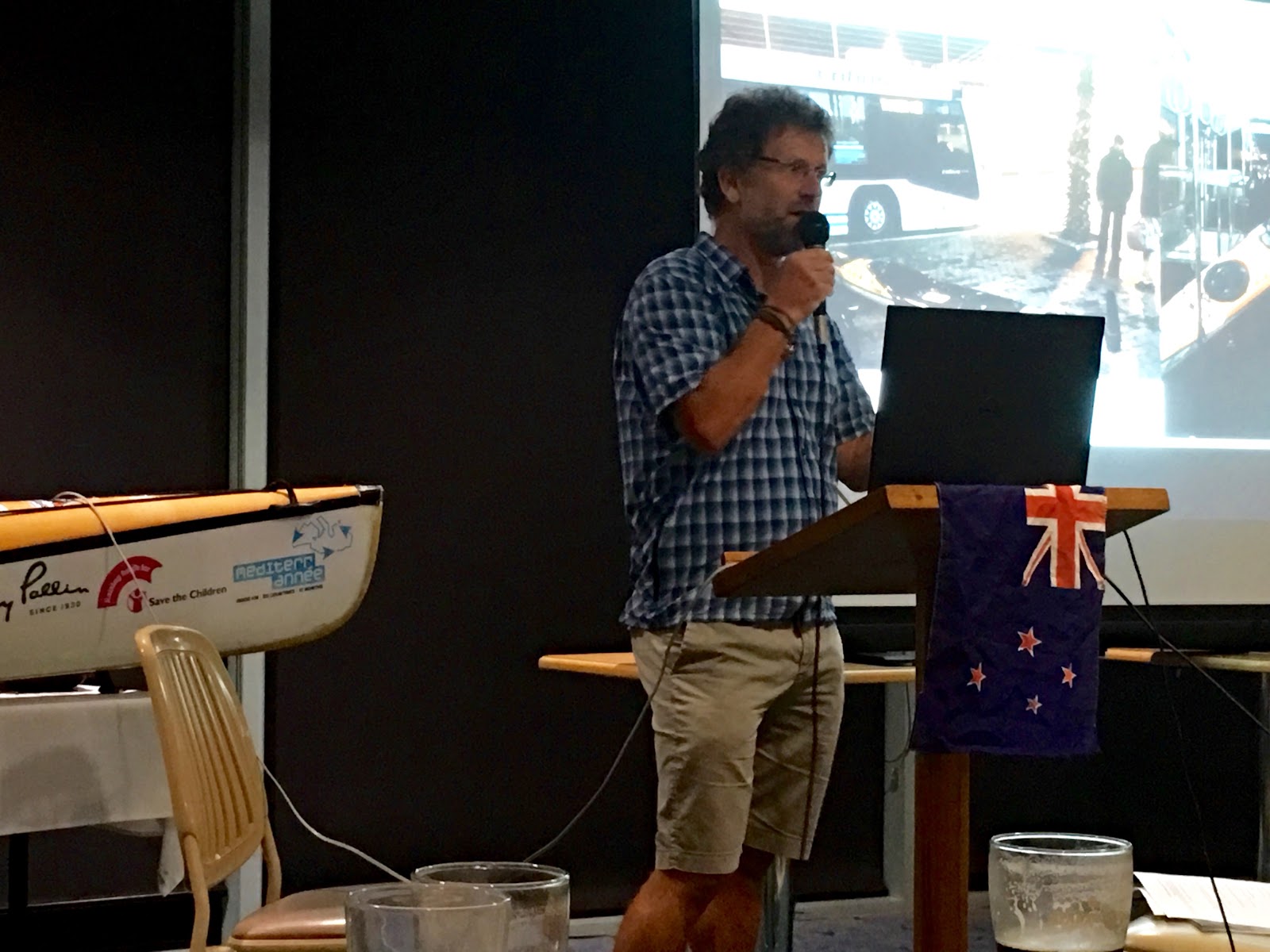
Huw Kingston came along on the Saturday night to tell the tall tale of his Mediter annee expedition, a near-circumnavigation of the Med by kayak, bike, foot, and eventually row boat, which began on Anzac Day at Gallipoli and finished on the 100th anniversary of Anzac, back at Anzac Cove. Can you even imagine how good it would be to go on an adventure like that....?!
My paddle was something of an unforgettable experience, for such a humble sea scootle. I had Stephen & Jenny down from Queensland who'd never paddled these waters, Christina, who this time last year hadn't even wanted to line up an island away yonder & paddle towards it, and Roy & Bronwyn, who are pretty seasoned, but have their own way of doing things.
Christina and the first pos of pesky dolphins.
You see, Bronwyn is blind, and Roy, her amazing husband, becomes her eyes as they regularly head off into the blue. They've rigged up a radio & mike which allows Roy to pass instructions to Bronny about direction, so his day consists of passing on a series of coded prompts to head to port or starboard etc etc. If you were wondering how hard that might be, blindfold a mate one day & try to direct them, not just with where to head, but how sharply to head there.
The remarkable Bronwyn
Up to Saturday, Bronwyn had only paddled in a rudderless skeg boat, the Tiderace Xcite S, where the prompt to 'Starboard' in the Xcite has her dropping her edge & using pure rudderless skill to change direction. On Saturday, as you do, she decided to challenge herself in a fast, narrow ruddered boat, the new Tiderace Pace 17S. It's a hull design that whilst still responding to an edge when you need it to, is better controlled over a long stretch by relying on the rudder, and executing very small course corrections with your feet.
Rampaging Roy after painting the slot red
I watched the pair of them making their way out of the calm of the bay & saw Bronny chucking in some big edges when prompted, and figured I might offer a bit of advice. When I'm coaching people on skis, especially downwind, I'll call out 'right foot' or 'left foot' to prompt them to head for the best part of a running wave. It's uncomplicated, doesn't refer to a direction, but rather a body part, and tends to get them co-ordinating a simple movement, with a simple result. I suggested it to Roy to see if it might get them making slightly smaller course adjustments, and he told me I'd have to use 'Port' & 'Starboard', as they do, otherwise I'd confuse things. As someone who recites the ditty 'no red port left' as I'm heading for a channel marker at night during the Hawkesbury Classic, like maybe 20 times, I figured that was just asking for trouble! Anyway five minutes with my less poetic commands & Bronny had sorted the radical turn problem, away we went, and I duly handed the nav duties back to Rampaging Roy.
Jenny gets a yee-haa
On the southern edge of Boondelbah Island the craggy shoreline has some nice little slots & rock gardens, and we made our way through them with everyone getting a thrill or two as the surge took them backwards towards the rocks. Jenny had a yee-haa moment or two and Roy committed some nautical vandalism, leaving little red bits of the Pace 17 demo on the rocks.
Around the Northern end the nor' easter had kicked up some fizzing clapotis or rebound, and as I turned to make sure everyone was dealing with it OK I saw Bronwyn busting a trail through the wave tops, looking very comfy. 'Maybe it's not that hard', I thought to myself, so I turned towards our island target in the distance, shut my eyes tight & paddled. Thirty seconds later, a few airswings and a late-exit-brace or two I opened them again to find I was side one to where I began & heading for the reef on the edge of the island. Not my thing, I reckon, this paddling rough water on the ocean without being able to see! Bloody hell.....
My guys heading for Boondelbah, the Uluru of the East.
After tucking in behind the edge of Cabbage Tree Island & leaving some more gelcoat on the rocks, we turned downwind to head back towards the bay. The outgoing tide was opposing the sea breeze and things steepened up appreciably, which made me a little concerned for how the group might handle the run home. In truth, I was thinking 'how are Bronwyn & Roy going to deal with this...?' Anyway, the moment the heat came on Bronwyn was off like a firecracker, carving along, chasing waves & basically tearing the arse out of it. I had to dig in very hard to catch her because Roy was struggling to foot it, and yell at her quite loud to !%$& slow down! 'Why?' she said. 'Because I can't frigging catch you' was my reply.
Bronwyn smokin' it....
We burned around Yaccaba Headland, saw our second bunch of pesky dolphins for the day, and dawdled the final couple of protected miles back to the beach. An inspiring and quite amazing day for me. As someone who is expected to look after people out there on the wild blue, I learned a lot and couldn't help but be awed by these two remarkable paddlers.
Highlights of the rest of the weekend included the short film festival the Pogies, which this year delivered enough entries to provide over an hour of grassroots, homemade paddling gratification. The winner was Lisa Bush, with a video featuring the single best bit of helmet cam filming I've ever seen (you can see it HERE). And of course, other than the scheduled events, the unscheduled ones provided the majority of the off-the-leash moments, and are what make this weekend such a beauty every year.
Chris, Stephen, Mark, Jenny & Bronwyn. Roy asked where the photo was, I told him, over there to Starboard, and it was actually Port, so he's not here.
A big back slap to the tireless David Linco, fresh from smoking it across Bass Strait, who ran a great show. It was his third and last Rock & Roll & he's set a pretty high bar for the next co-ordinator. Well done Davlin!
Sharon & Rob enjoying the Elvis tunes at the dinner, until they were controversially unplugged.
Thanks also to those of you who came along to say G'day to us on our stand, swap a yarn or share a beer; we love being involved in our paddling community and hangin' out with our club mates. See you in 2017, Gazza hoping you'll be back......
Here's a very comprehensive review of Mick MacRobb's newest sail design, the Trade Wind 80, from Douglas Wilcox (http://seakayakphoto.blogspot.com.au).
Photo courtesy Douglas Wilcox (http://seakayakphoto.blogspot.com.au)
Flat Earth Kayak Sails "Trade Wind 80" long term test, by Douglas Wilcox. The number of sea kayakers paddle sailing in British waters, particularly with Flat Earth Kayak Sails, has increased tothe extent that designer Mick MacRobb chose Scotland for the World launch of his latest design! It is called the TradeWind 80 sail and has a new cut and a new trilaminate Grand Prix cloth. Design and construction The Trade Wind 80 is available now, other sizes will follow. It is 0.8sqm in area. This is the most popular size as it hasthe widest wind range. Compared with the current Code Zero sail, it has a slightly shorter luff and has more sail area inthe head and roach (upper rear). The outline is more similar to the current P&H version of the sail but the cut andmaterial are different. The new Grand Prix sail cloth is a mylar/scrim/mylar trilaminate. The scrim is made up of carbonand kevlar yarns so it is very resistant to stretching or tearing. This type of trilaminate material is very tough andresistant to UV and has been long used on windsurfer wave sails and they take a real thrashing. The previous Code Zerocloth is great when new. It is a thinner, lighter mylar/dacron bilaminate but it tends to soften with repeat folding andthis may be why the leaches of some older Code Zero sails "motor" or flutter in stronger winds. I suspect this will not bean issue with the Grand Prix cloth. It is partially see through. There is no window option but recent Code Zero 0.8 andall P&H branded Code Zero sails had dropped the window. If you use the standard mast, the window only gave a view ofthe sky anyway.
Photo courtesy Douglas Wilcox (http://seakayakphoto.blogspot.com.au)
The Trade Wind 80 is the fourth generation of the Flat Earth sails that has been available in Europe. It has less twistthan previous generations of Flat Earth sails, particularly the first and second generation dacron sails. The twist madethe early sails forgiving in gusts but due to the head twisting off , the boom needed to be kept sheeted in a bit whensailing downwind to prevent the roach of the sail moving forward of the mast and spilling wind. The new sail can besheeted out more on the run making it more efficient. With less twist, the new sail is indeed a bit more unforgiving andas Mick MacRobb says "aggressive" than the original sails but will retain more power before auto spilling the wind. Whenthe Trade Wind 80 is sheeted in a little further in a reach position I think the fullness low down looks a little furtherback than in the previous Code Zero which will make it a little more powerful for its size especially on a broad reach.When sheeted right in on a beat the head of the sail is flatter than previous versions but there is still plenty fullnesslow down. As a windsurfer, I have always liked using sails with a deep belly, a flat head and a roach with controlledtwist for their wide wind range. As a sea kayaker, I like this style even more. I think Mick has really nailed it withthis particular cut! The boom of the new sail sits higher on the standard mast than previous sails. This gives all round vision under the sail.You could cut the mast top down and lower the sail but I am not going to do that. I like the sail up higher as the windgets slower and more turbulent the closer down it is to the surface of the sea. The batten, boom and gooseneck fitting areunchanged from previous generations of the sail. Also unchanged is the neat and expert way the sail has been cut,assembled and sewn.
The old Code Zero 80 compared to the Trade Wind 80
Photo courtesy Douglas Wilcox (http://seakayakphoto.blogspot.com.au)
On the water Phil Toman and I received preview sails at the end of the winter and since then we have extensively tested them onunloaded P&H Quest, Delpin, Aries (with forward fin) Cetus MV and Valley Nordkapp LV kayaks. The Quest and Cetus MVhave also been tested with the sail when fully loaded on camping trips. We were able to test the sails side by side withall three previous generations of FEKS on identical P&H Aries and Cetus MV kayaks.
Test conditions varied from force 2 to force 4 on exposed (quite rough) water and force 5-6 on sheltered (pretty flat) waterwith a fetch of 15km. The sails have been tested in the tidal waters of the Sound of Jura and the Solway Firth, in exposedwaters at the mouth of the Firth of Clyde, in more sheltered water among the islands of the Firth of Clyde and along theexposed North Sea coast between Lunan Bay and Arbroath. Between us we have covered over 500km with the Trade Wind 80sails. After the sail arrived I wasted no time in getting it out onto the water on my P&H Delphin. The wind was very gustyoffshore in a sheltered bay from F2 to the bottom of F5. The sea was flat. On all points of sail the sail set with anoticable lack of wrinkles. When launching the sail, it goes up with a satisfying wumph! One thing to note is that the topbatten is now longer than the mast. When launching in stronger winds I like to hold the sail by the tip of the mast for afew seconds and allow the sail to blow free before pulling the uphaul to fully hoist the sail. This checks that I have notfolded the sheet right round the sail when I previously furled it. Initially I found myself holding the top batten ratherthan the mast but I have since learned to go for the shorter mast. The sail has less twist and so is indeed a little lessforgiving when you launch it on a broad reach than the original all dacron version. Code Zero and P&H branded FEKSsail users will probably not notice much difference though. The very gusty winds were a good test for me (a relativelyexperienced paddle sailor) to see how a newcomer might find the sail in steadier, lighter conditions. Well it was notrouble at all. I liked everything about it, launching, tacking upwind, on a reach, running, gybing and furling. Therewere no scary moments even in the most sudden gusts. In the strongest winds there was not a hint of the leech "motoring".
Photo courtesy Douglas Wilcox (http://seakayakphoto.blogspot.com.au)
Downwind This sail proved very controllable and powerful downwind in stronger winds. In winds at the top of F4 it gives the extrapower to your paddling to overtake the wave in front then climb over it and chase the next wave. The GPS showed my maximumspeed hit 22.9km/hr when paddle sailing the Aries hard in a F4 with following sea and I was frequently hitting over20km/hr when planing on a wave. The cut and heavier cloth give the Trade Wind 80 sail a very stable feel downwind. Whenyou drop off the plane you slow down and the apparent wind increases (you should paddle hard at this point to maintainspeed and reduce the load on the rig). In the older dacron sails if you suddenly slowed, the leech would suddenly twist off spilling wind but this moved thecentre of effort and made the sail feel a little unstable. This sail continues to pull hard when you decelerate but in noway does it feel unstable. My one reservation for someone upgrading from a dacron sail is that undoubtedly the stays willbe transmitting more force to the hull, especially if you are loaded with expedition gear. You may wish to reconsider yourexisting stay anchors. I now use two side stays and two back stays, all anchors are bolted through the kayak seam.
Upwind. Many kayakers will not bother to use their sails upwind but it is worth the effort learning how to do so. The Grand Prixsail material is stiffer than the original dacron material and it is a little more difficult to judge how high to the windyou can paddle sail without luffing (back winding) the sail. The softer dacron sails definitely showed the when theleading edge back winded at an earlier stage. I was not bothered by this but if beginners are particularly concerned aboutbeating performance (rather than just blasting downwind having fun) they could thread a wool tell tale through the luff ofthe sail about half way up and in front of the batten. The tell tale should blow horizontal sailing close as possible tothe wind but if you point too high into the wind it will start to move vertically. Swapping between two Aries kayaks, onewith the Code Zero and one with the Trade Wind 80, the experienced paddler found it easier to out point the other paddler when using the Trade Wind 80 upwind in a F3-F4.However, down wind there was little difference in speed between the two sails. Interestingly the flat area behind andabove the batten often appeared to be back winding when close hauled but the full part of the sail below the battencontinued to pull strongly. One thing I did notice about the new sail is I find it easier to control upwind in strongerwinds. It feels much more stable than the previous dacron versions of the sail. Although they may be softer and moreforgiving, they lack the feeling of stability and power of this new sail. I think the Trade Wind 80 sail's very solid feelis due to its centre of effort being much more static. Basically I like the feel of Trade Wind 80 a very great deal whengoing upwind. It also proved particularly effective upwind in combination with the Aries using a forward fin.
Use when fully loaded on expedition Paddling sailing fully loaded on expedition is very rewarding especially with a favourable wind at the end of the day.However, the kayak will not accelerate so quickly in the gusts and unless you are lucky with the waves it will be verydifficult to get it planing. This means you will be travelling slower and when you are paddling downwind the apparent windwill be greater with greater forces acting on the rig. This is another situation where it is important to continue topaddle hard to reduce the pressure on the rig. This is also why I think the 0.8 sqm sail is more suitable for all-roundpaddle sailing including expedition use than the 1.0sqm sail. We were recently paddling south down the West Kyle of Butewhen a "securite" strong north wind warning was broadcast on the VHF. In the relative shelter, the water was flat but thesqualls were coming through the mountains at F5-F6 from various angles. All the yachts dropped their sails and motoredhome under bare poles. We carried on paddle sailing on a very broad reach. We were in identical Cetus MVs loaded withsupplies for 5 nights camping. I had a Trade Wind 80 and Mike had a Code Zero 0.8. In these extreme conditions there was alot of load on the rigs and I think I had an easier time controlling the Trade Wind 80 than Mike did with the Code Zero.Two days later we enjoyed a more moderate F3 to F4 downwind blast of 30km across open waters of the Sound of Bute and itwas more difficult to differentiate between the two sails' performance and handling.
Wear and tear At the end of this test there was no sign of wear, cracking or delamination in either of the sails on test or thematerial.
Conclusions I like what Mick MacRobb has called the "slightly more aggressive" nature of the Trade Wind 80 sail. I felt more of thegust was being transformed into forward drive rather than spilling out off the roach as the sail twisted. The definingcharacteristic of the Trade Wind 80 is a very stable centre of effort. This makes paddle sailing at the top of yourability and conditions range a joy! This is steady evolution, it certainly won't make your Code Zero or P&H FEKS sailredundant. However, if you have one of the original all dacron (or dacron with mylar reinforcement on the leech) FlatEarth sails, then changing to the Trade Wind 80 would make a significant and noticeable upgrade. You could always sellyour old dacron sail to a newcomer to paddle sailing, who might not yet be ready to invest in a new sail and who wouldappreciate the older sail's softer feel in lighter winds. If you are new to paddle sailing do not be put off by the hightech appearance of the Trade Wind 80, it is actually very easy to handle, especially in the lighter winds you should getto know it in. If you already have a Code Zero or P&H FEKS, the incremental improvement is probably not worth anupgrade at this time, unless you just MUST have all the latest kit! The biggest difference in performance is in winds that will probably be at the top of most people's comfort zones anyway but it alsoexcels if you like going upwind in F4 winds. I cannot think of a better day or expedition sail for paddle sailing in allweathers, summer and winter. If you are in the Southern Hemisphere keep an eye on the Expedition Kayaks web site as they are main distributor in theFEKS's native Australia.
Conflict of interest Phil and I have been using free loan sails that remain the property of Flat Earth Kayak Sails, the only cost to us was thepostage from Australia. I have however, bought three other FEKS sails at full price. Neither Phil nor I have any financialinterest in FEKS.
We have stock on the shelf for $390 including shipping nationally, you can order HERE